The short answer
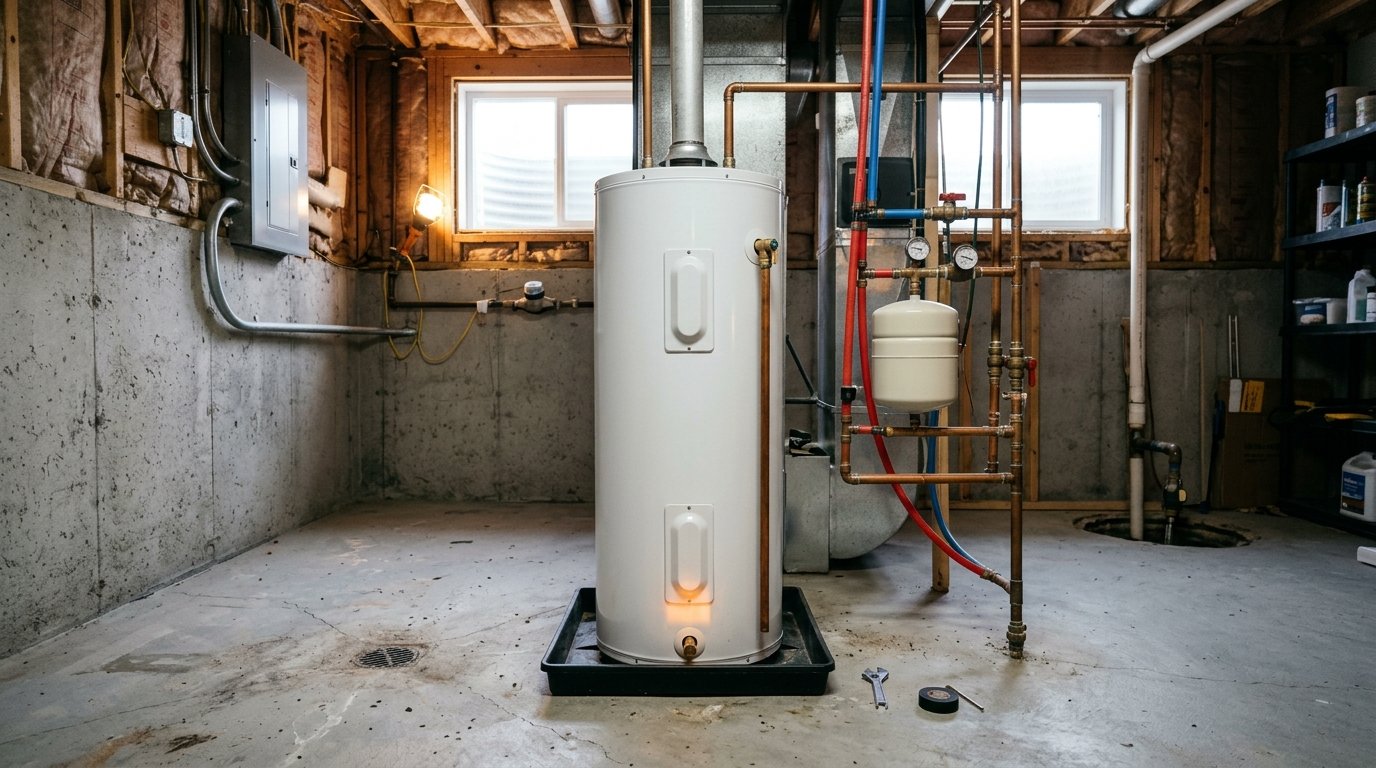
A conventional (atmospheric) gas water heater vents up a chimney or metal B-vent and needs no electricity, a power vent water heater uses a fan to push exhaust out through a side wall, and a direct vent water heater takes its combustion air from outside and vents through the wall in a sealed system. Which one suits your home depends mostly on whether you still have a usable chimney, how airtight the house is, where the tank sits and whether hot water during a power outage matters to you.
That choice usually comes up when a hot water tank needs replacing, and it is easy to miss because most people simply ask for "the same tank again." This guide compares the three types, explains the chimney problem many Chestermere homes run into after a furnace upgrade, and lists the questions to ask before you book hot water heater replacement in Chestermere.
Why venting matters when you replace a water heater
A gas water heater burns fuel, and the exhaust has to leave the house safely. Natural Resources Canada's Water Heater Guide describes two basic ways of doing that in today's homes: "traditional venting that uses a chimney and sidewall venting." It also makes a point that matters on every replacement: "An evaluation by qualified service personnel is required when adding, removing, or replacing any gas-fired, propane or oil-fired equipment."
The venting type affects:
- Where the tank can go. A chimney-vented tank has to sit fairly close to the chimney. A side-wall vented tank needs a route to an outside wall that meets code clearances.
- What happens in a power outage. Some types need electricity to run.
- Safety in a tight house. Some types can spill exhaust back into the home if the house is depressurized by other fans.
- Installation cost. Changing from one type to another can mean new venting, a new electrical outlet or work on the chimney.
Conventional (atmospheric) gas water heaters
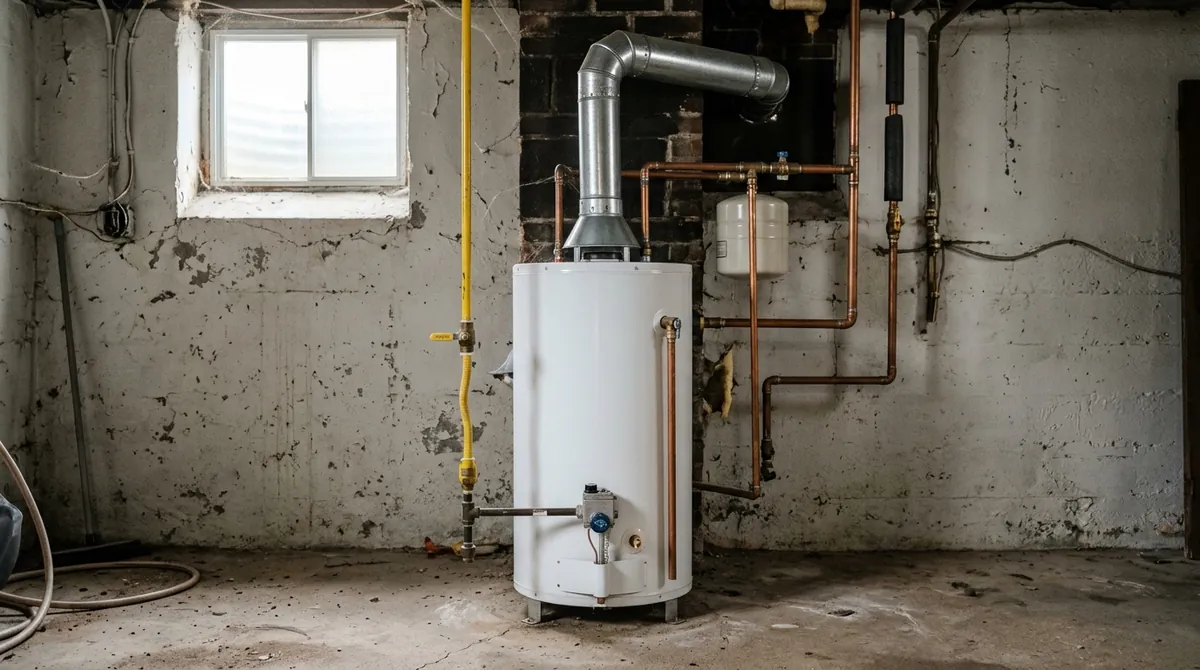
This is the most familiar setup: a tank with a metal draft hood on top and a vent pipe running into a chimney or a metal B-vent. The hot exhaust rises on its own because it is lighter than the surrounding air.
What works well
- No electricity needed. NRCan notes that conventional gas water heaters "can provide hot water during power outages."
- Usually the simplest like-for-like replacement when the existing chimney or B-vent is in good shape and sized correctly.
- Quiet, with no fan.
The drawbacks
- Lower efficiency. NRCan describes these tanks as "rather inefficient because they use naturally aspirated burners, continuous pilot lights and have constant energy losses up the chimney."
- Spillage risk. They use house air for combustion, and NRCan warns that they "can spill combustion gases if the house depressurizes." Kitchen and bathroom fans, clothes dryers and fireplaces all pull air out of the house and can work against the water heater's draft.
- They depend on the chimney. If the chimney is too large, damaged or no longer shared with a furnace, it may need work before a new tank can use it.
Power vent water heaters
A power vent water heater looks much like a conventional tank, but with a fan on top. NRCan explains that "a fan pushes the exhaust gases through a vent out the side wall of the house," which means no chimney is needed. The vent pipe is usually plastic and can run some distance to an outside wall.
What works well
- No chimney required. NRCan says this type "may be a good option where no chimney exists or where the cost of chimney lining would be high."
- Resistant to backdrafting. NRCan notes that power venting "eliminates the possibility of backdrafting and spilling combustion gases."
- Electronic ignition instead of a standing pilot, which helps efficiency a little. NRCan is careful to add that "the efficiency improvement over conventional water heaters is fairly small."
- More flexible placement, because the tank does not have to sit next to a chimney.
The drawbacks
- No hot water in a power outage. These tanks "require electricity, so they cannot produce hot water during a power outage."
- Fan noise and an extra part to fail. NRCan's comparison table notes that "some power vents are noisy and prone to failure."
- A higher purchase price than a conventional tank, and an electrical outlet near the tank if there is not one already.
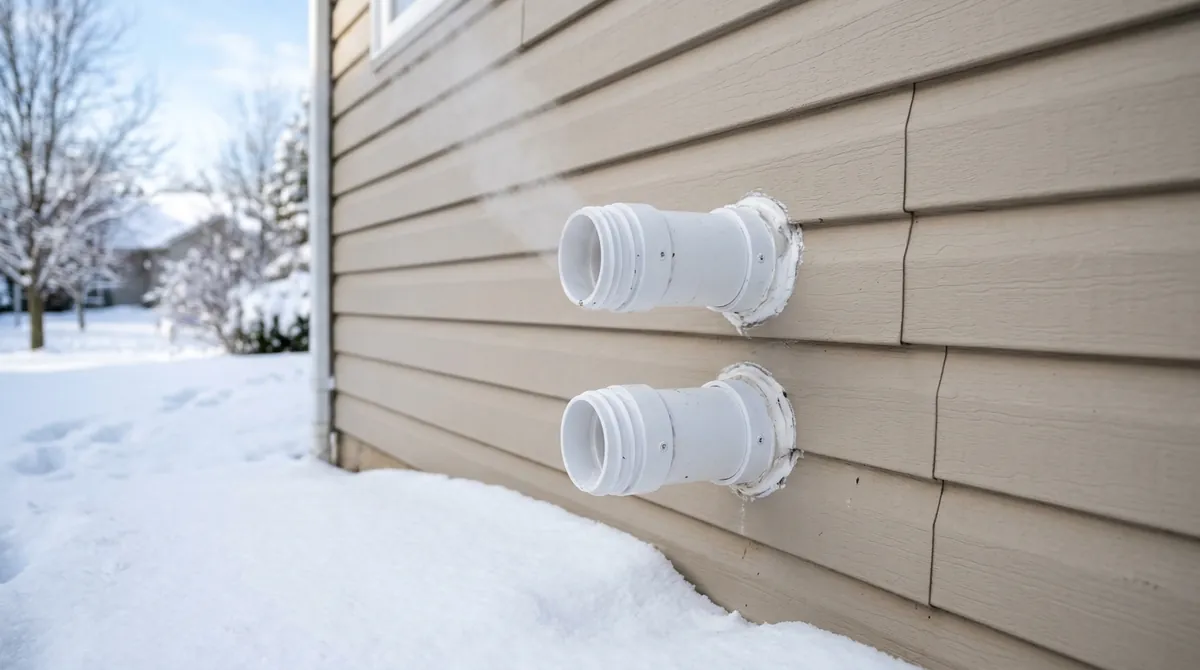
Direct vent water heaters
A direct vent water heater, also called sealed combustion, draws its combustion air from outside and sends the exhaust back outside through the wall. In NRCan's words, it draws "combustion air from outside the building directly into the combustion chamber. This means that house air is not used for combustion."
NRCan notes that direct vent water heaters "are available with or without a power-vent fan. Both types are more resistant to combustion spillage than a conventional water heater." The versions without a fan rely on natural draft through a short horizontal vent, which limits how far the tank can be from the outside wall. Power direct vent models add a fan, which allows longer pipe runs but brings back the need for electricity.
What works well
- The safest option in a tight house, because the combustion side is sealed from the indoor air.
- No chimney required.
- Non-powered models keep working in an outage.
The drawbacks
- Placement limits for non-powered models, which usually need to sit close to an outside wall.
- Usually a higher price than a conventional or power vent tank.
- Two pipes or a concentric vent through the wall, which must meet clearances from windows, doors, gas meters and the ground.
The orphaned chimney problem after a furnace upgrade
This is a common situation in older Chestermere homes. The house was built with a mid-efficiency furnace and a gas water heater sharing one metal chimney. Later the furnace was replaced with a high-efficiency model that vents through the side wall with plastic pipe. The water heater is now the only appliance using a chimney that was sized for two.
A chimney that is too large for one small appliance can draft poorly and allow condensation to form inside it. NRCan's guide puts it plainly: "Resizing and/or lining the chimney or vent may be necessary to avoid combustion gas spilling into the house and to avoid condensation forming in the venting system."
When the water heater is due for replacement in a home like this, there are usually three choices:
- Keep a conventional tank and reline or resize the chimney so it suits the water heater alone.
- Switch to a power vent tank, vent it through the side wall and stop using the chimney.
- Switch to a direct vent or tankless unit, also vented through the wall.
The right answer depends on the condition of the chimney, the distance to an outside wall and how much the household values hot water during an outage. If you are planning furnace replacement in Chestermere and your water heater shares the chimney, it is worth looking at both appliances together.
Newer, tighter homes
Many homes in newer Chestermere communities are built tight to save energy, and older homes become tighter after new windows, weatherstripping and insulation. NRCan's advice for these houses is specific: "If you have a newer house, or have significantly reduced the air leakage in your house with caulking, weatherstripping and new windows, you should consider installing a power-vented water heater or a sealed combustion water heater, thus eliminating the possibility of spillage and backdrafting."
The same guide adds that, as a minimum, you should install a carbon monoxide alarm near all combustion appliances, which "is required by building code in many Canadian jurisdictions." Whatever type of water heater you choose, a working CO alarm in the basement is part of a safe setup.
Side-by-side comparison
| Conventional | Power vent | Direct vent | |
|---|---|---|---|
| How it vents | Up a chimney or B-vent, by natural draft | Fan pushes exhaust out a side wall | Sealed: outside air in, exhaust out through the wall |
| Needs a chimney | Yes | No | No |
| Needs electricity | No | Yes | Only power direct vent models |
| Hot water in a power outage | Yes | No | Yes, for non-powered models |
| Uses house air for combustion | Yes | Yes, in most single-pipe models | No |
| Resistance to spillage | Lowest | High | High |
| Placement | Close to the chimney | Flexible | Near an outside wall (non-powered) |
| Noise | Quiet | Fan noise | Quiet unless powered |
Questions to ask before you choose
Bring these to whoever quotes your replacement:
- Is my chimney or B-vent the right size and condition for the new tank on its own?
- Does my water heater still share the chimney with the furnace, or was the furnace changed to side-wall venting?
- How far is the tank from an outside wall, and where would a side-wall vent come out?
- Is there an electrical outlet near the tank, or does one need to be added?
- How important is hot water during a power outage for our household?
- What size tank do we need? Our guide to tank vs tankless water heaters in Chestermere helps with capacity, and our guide to hot water tank replacement cost explains what moves the price.
A clear quote should name the venting type, the venting work included, any electrical work, the removal of the old tank and the permit.
Water heater venting in Chestermere homes
Chestermere winters add a few local details. Side-wall vents need to stay clear of snow drifts and ice, so the outlet height and location matter on the side of the house where snow piles up. Exhaust and intake terminations also need to keep their required distance from windows, doors and the gas meter, which can rule out the easiest-looking spot on a tight lot. In some older homes, the basement layout puts the tank far from an outside wall, which favours a conventional tank with a relined chimney or a power vent model with a longer pipe run.
Book hot water heater replacement with Infinite Heating
Infinite Heating is a licensed and insured HVAC team based in Chestermere, replacing gas hot water tanks for homes in Chestermere and nearby communities since 2022. We look at your existing venting, chimney and household demand, tell you plainly which types will work safely in your home, and give you a clear quote before any work starts.
Learn more about hot water heater replacement in Chestermere or our hot water heater replacement service, or contact us to book a visit.
This general information does not replace an on-site assessment by a qualified professional or the manufacturer's instructions for your water heater. If you smell gas or your CO alarm sounds, leave the home and call your gas utility or 911 from outside.