The short answer
If your water heater is leaking, turn off its gas or power, close the cold water valve above the tank, and keep the area dry while you find where the water is coming from. A leak from the relief valve, the drain valve or a pipe fitting can usually be repaired, but a leak from the tank body itself cannot, and that tank needs replacing.
The location of the water tells you most of what you need to know. This guide walks through what to do in the first few minutes, how to trace the source, and how to tell a repair from a replacement. If you would rather have someone look at it now, our hot water heater repair in Chestermere service starts with finding the source and telling you plainly which one you are dealing with.
What to do first
A small puddle is not an emergency, but it can turn into one in a finished basement. Work through these steps in order:
- If you smell gas, stop. Do not touch switches or try to relight anything. Leave the house and call your gas utility's emergency line or 911 from outside.
- Turn off the heat source. On a gas tank, turn the gas control knob to "Off" or "Pilot". On an electric tank, switch off the double-pole breaker that feeds it.
- Close the cold water supply. The shut-off valve is on the cold line going into the top of the tank. Closing it stops the tank from refilling, which limits how much more water can escape.
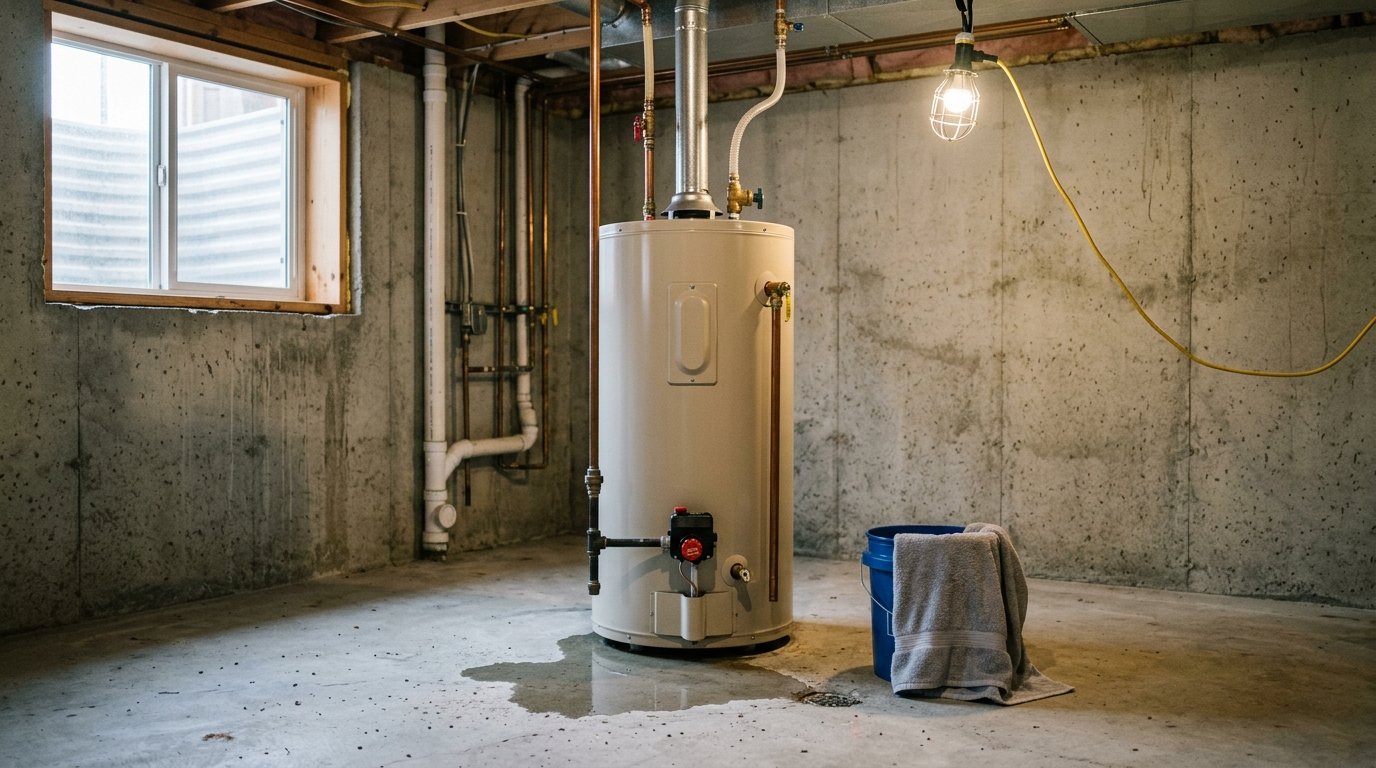
- Protect the floor. Move boxes and stored items away, lay down towels, and put a tray or bucket under any drip. Carpet and drywall near a utility room soak water up quickly.
- Do not open the relief valve or drain the tank to "test" it. The water inside can be hot enough to scald, and an old drain valve that is opened after years of sitting may not close again.
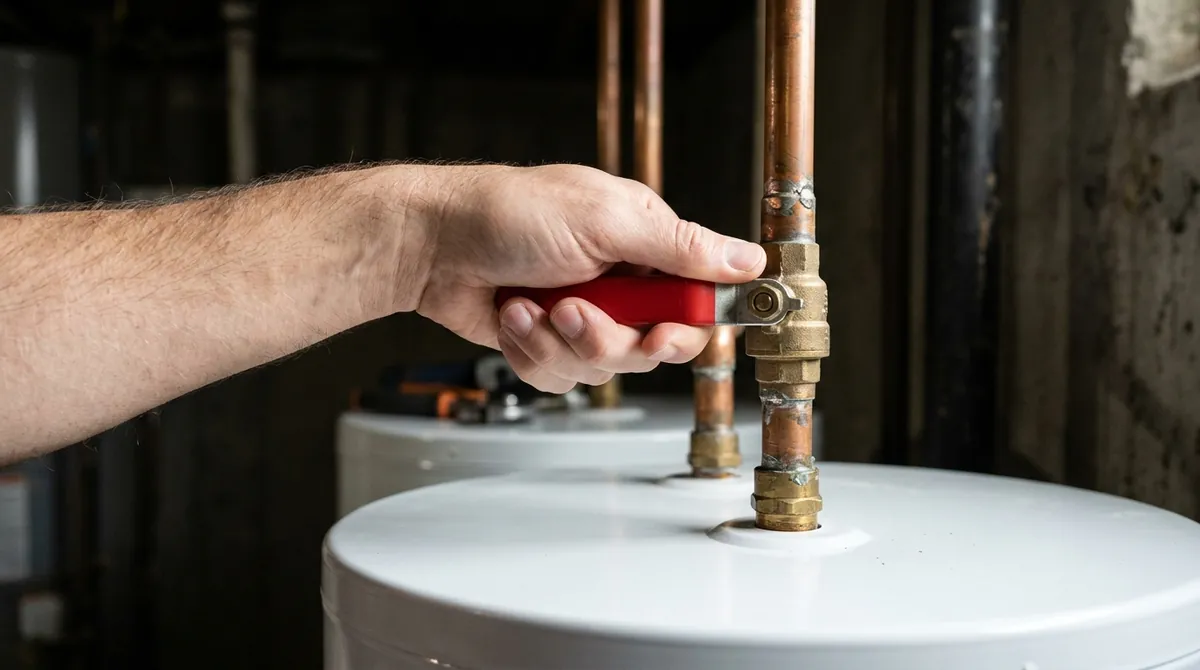
Once the heat source and cold supply are off, the tank is no longer heating or refilling, and you have time to work out what is going on.
How to find where the water is coming from
Water runs down and spreads, so the puddle is often not directly under the leak. The simplest method works best: dry everything you can reach, then watch where new water appears. Check these places, from the top down:
- The pipes and fittings on top of the tank. Look at the hot and cold connections, any flexible connectors, and the shut-off valve.
- The temperature and pressure (T&P) relief valve. This is the brass valve on the top or upper side of the tank, with a pipe running down toward the floor. Water dripping from the end of that pipe means the valve is opening.
- The drain valve near the bottom. Look for drips from the spout or around the base of the valve where it threads into the tank.
- Under the burner access cover on a gas tank. Water here can be condensation or a sign the tank is leaking internally.
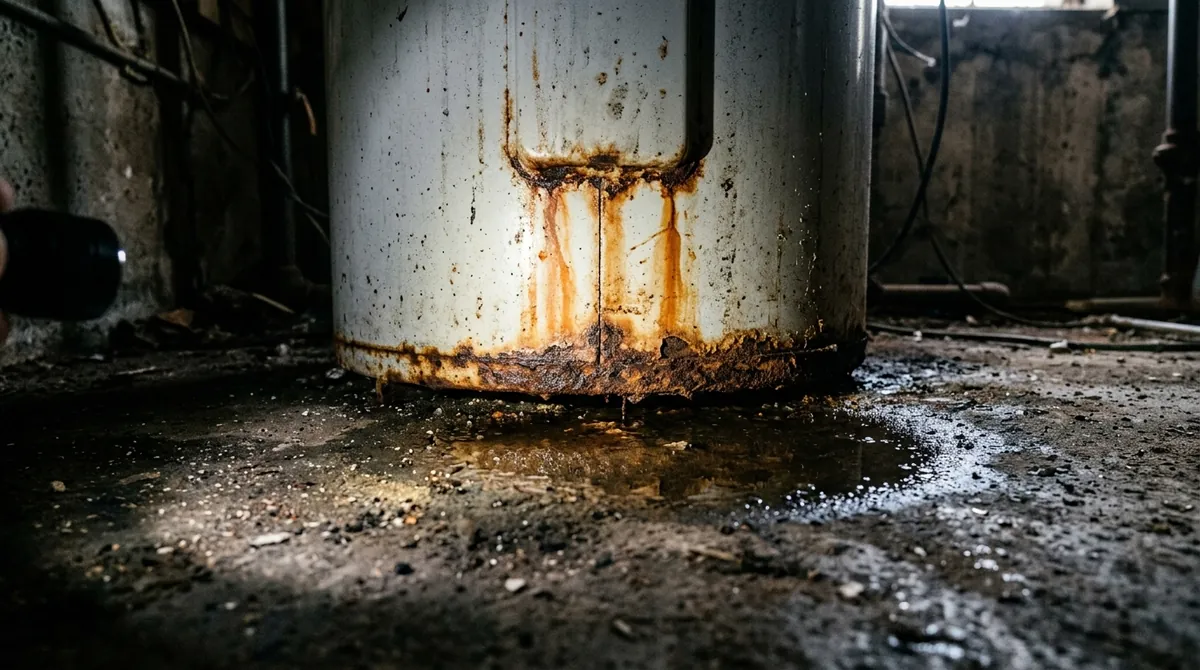
- The tank jacket and base. Rust streaks, wet insulation or water pooling under the tank with no source above it usually point to the tank itself.
Condensation is not always a leak
A gas water heater can produce condensation, especially when a full tank of cold water is heating up. Moisture forms on the cool inner walls, drips onto the burner and can sizzle or leave a little water under the unit. This tends to be worse after heavy hot water use and usually stops once the tank is up to temperature. If the water keeps appearing when the tank is fully hot and no one has used hot water for a while, it is more likely a real leak.
Leaks that can usually be repaired
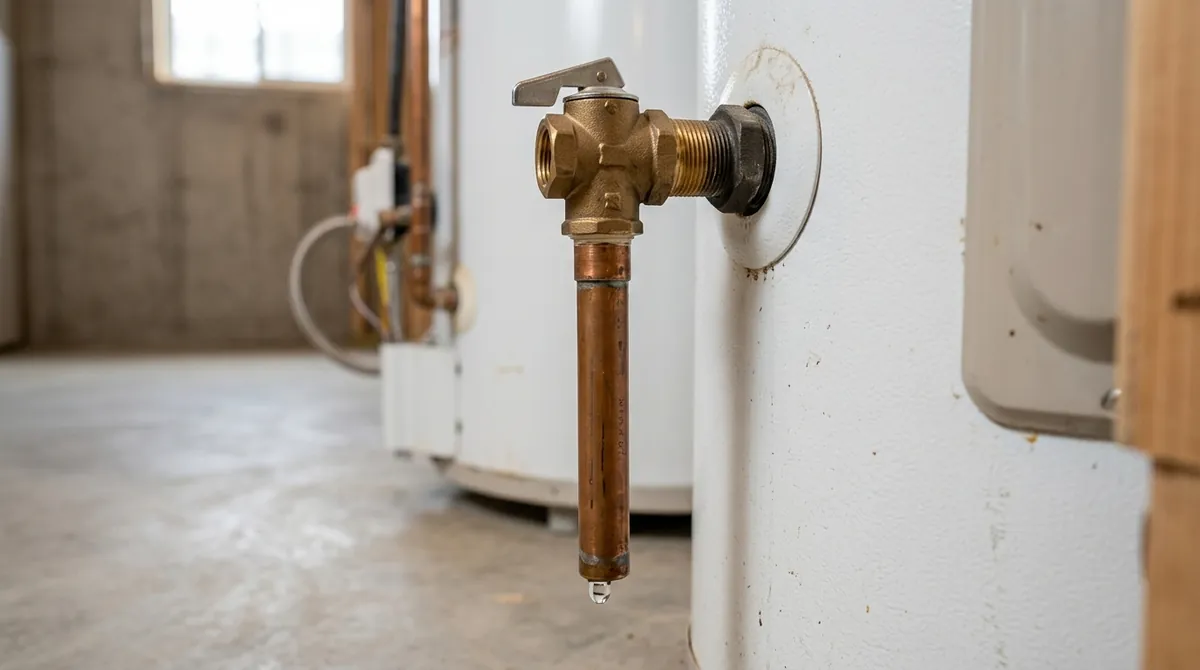
Most leaks from parts attached to the tank are repairable, because the part can be replaced without replacing the tank.
**The T&P relief valve. ** This valve is a safety device. It opens to release water if the temperature or pressure inside the tank gets too high, which is exactly what it should do. A valve that drips or discharges regularly means one of three things: the valve itself is worn and needs replacing, the water pressure in the house is too high, or the water is overheating because of a thermostat or control fault. Replacing the valve without finding out which one it is can just move the problem. A technician checks the household water pressure and the thermostat before deciding.
In homes with a closed plumbing system, high pressure from thermal expansion is a common cause, and an expansion tank may be part of the fix. Never cap or plug the discharge pipe. That removes the tank's last line of protection.
The drain valve. Plastic drain valves on many tanks become brittle over time and can drip from the spout or crack. A drain valve can usually be replaced, although the tank has to be drained first.
Inlet and outlet fittings. Loose or corroded connections at the top of the tank, worn flexible connectors and leaking shut-off valves are common, and they are straightforward repairs. Corrosion at these fittings is worth taking seriously, because it can also be a sign the tank's internal protection is used up.
Gas burner area. If the water under a gas tank is condensation from a cold tank or a venting issue, the fix is about the conditions, not the tank. A technician checks the venting, the burner and the thermostat setting.
If your tank has also stopped heating properly, our guide to a water heater not producing hot water covers those symptoms.
Leaks that mean the tank needs replacing
A leak from the steel tank itself cannot be repaired. Tanks are lined with glass and protected by a sacrificial anode rod. Once the anode is used up and the lining fails, water corrodes the steel from the inside, and the leak will only grow. Signs of a tank-body leak include:
- Water pooling under the tank with no drip from any valve or fitting above it
- Rust-coloured water from the hot taps, or rust streaks down the jacket
- Water coming from under the jacket or the bottom seam
- A tank that is wet inside the burner compartment even when it is fully hot
Water quality plays a part. Chestermere receives its drinking water from the City of Calgary as a regional water customer, and the City's 2025 data shows hardness of 141 to 274 mg/L as calcium carbonate. Hard water leaves mineral sediment at the bottom of a tank.
That sediment makes the tank run hotter at the base, can make the drain valve harder to use, and adds to wear on the tank over the years.
When the tank body is leaking, the useful next step is planning the replacement, not a repair. Our guide to hot water tank replacement cost in Chestermere explains what affects the price, and the hot water heater replacement in Chestermere page explains how we handle the install.
Repair or replace: how to decide
The location of the leak decides most cases, but a few other things matter when the leak is at a valve or fitting:
- Age. Find the manufacture date on the rating label on the side of the tank, or ask a technician to read it from the serial number. A valve repair on a young tank makes sense. The same repair on a tank near the end of its expected life may only buy a short time.
- Other symptoms. A tank that is also rumbling, running out of hot water early or producing rusty water is telling you more than a single drip does.
- Where the tank sits. A tank in a finished basement or next to a furnished room carries more risk if it fails completely. Some homeowners choose to replace an older tank early rather than risk the damage.
- What else is due. In many newer Chestermere communities, the water heater and furnace went in at the same time. If one is near the end of its life, it is worth knowing the age of the other.
A good technician will show you where the leak is, explain whether it is a part or the tank, and give you the repair option and the replacement option side by side when both are reasonable.
What to tell us when you call
You will get a clearer answer faster if you can share:
- Whether the tank is gas or electric, and roughly how old it is
- Where you found the water and whether it is still appearing after you shut things off
- Whether water is coming from the relief valve pipe
- Any other symptoms: no hot water, rusty water, noises, a pilot that keeps going out
- Where the tank is: unfinished utility room, finished basement, garage or closet
A photo of the rating label and of the area around the tank also helps.
Water heater leaks in Chestermere homes
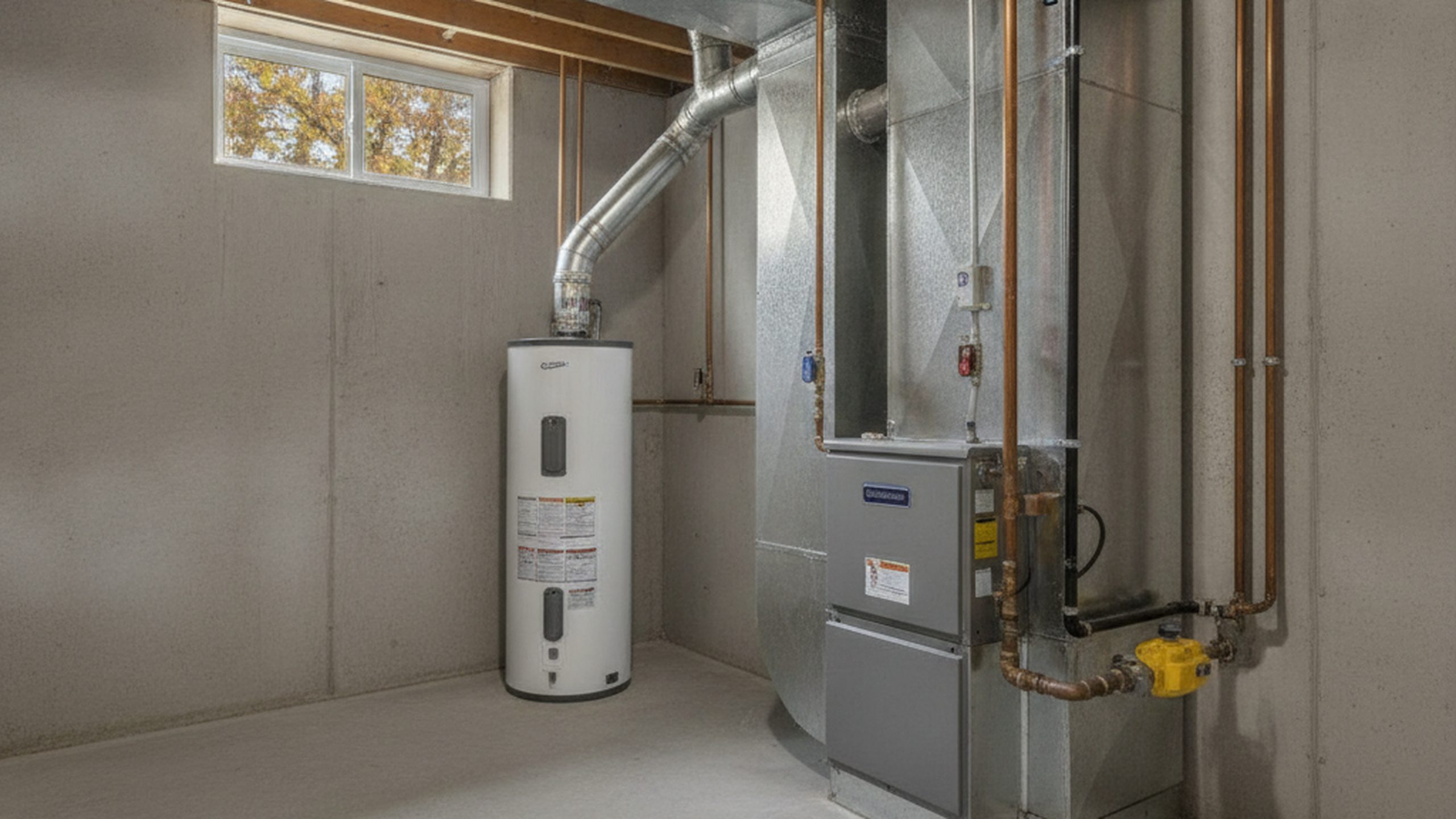
Most water heaters in Chestermere sit in basement utility rooms, often beside the furnace and close to finished living space. That makes a slow leak easy to miss until it reaches flooring or drywall. A quick look around the base of the tank when you change your furnace filter costs nothing and catches most leaks early.
The hard water supply also means sediment builds up faster than in soft-water areas. Periodic flushing, following the manufacturer's instructions, helps, but on an older tank that has never been flushed it is worth having a technician look at the drain valve first.
Book hot water heater repair with Infinite Heating
Infinite Heating is a licensed and insured HVAC team that has served Chestermere and nearby communities since 2022. When a tank is leaking, we find the source, explain whether it is a part we can replace or a tank that has reached the end of its life, and talk you through the options before any work starts.
Learn more about hot water heater repair in Chestermere, read the full hot water heater repair service guide, or contact us and tell us what the tank is doing.
This general information does not replace an on-site assessment by a qualified professional or the manufacturer's instructions for your water heater. If you smell gas, leave the home and call your gas utility from outside.